

Mnemonic Data Sculpture · Sound data · 2023
Call for Life
Yaşama Çağrı
A rescue call from the February 6, 2023 earthquake, made permanent in form.
The work
A moment of hope from inside a collapsed building in Hatay, turned into a sculpture where every ridge is a frequency of a human voice.
“Does anyone hear my voice?”
“Sesimi duyan var mı?” — a rescue team, Samandağ, 7 February 2023
On 6 February 2023 two earthquakes struck southeastern Türkiye, affecting eleven provinces and more than fifty thousand lives. In the days that followed, rescue teams entered collapsed buildings calling out the same phrase, hoping for an answer. A recording of one of those calls, made during the search in Samandağ, Hatay on 7 February, is the source material of this work.
Call for Life is a Mnemonic Data Sculpture. The recording was separated into its frequencies with Fast Fourier Transform analysis and each frequency was translated, in real time, into a generated three-dimensional form. The voices and words in the recording became the physical formations on the sculpture’s surface. The general rules of the form are set by the artist; every shape within those rules comes directly from the sound.
The work was first released as an NFT in sixty editions to raise emergency relief funds. It sold out, and all proceeds were donated to earthquake relief. It was then exhibited in New York, produced as a 3D-printed sculpture for İGA ART, and recognised by the Lumen Prize. Beyond the fundraising, its purpose was to create an anchor for a moment that would otherwise be lost in the flood of information: something that can be remembered together, in the longer term.
From sound to form
Every ridge is a frequency
A waveform shows only loudness over time. FFT analysis separates a recording into its individual frequencies, the way DNA sequencing separates a sample, so that voices, footsteps and machinery become visually distinct. Those separated frequencies, plotted against time, drive the generative form.
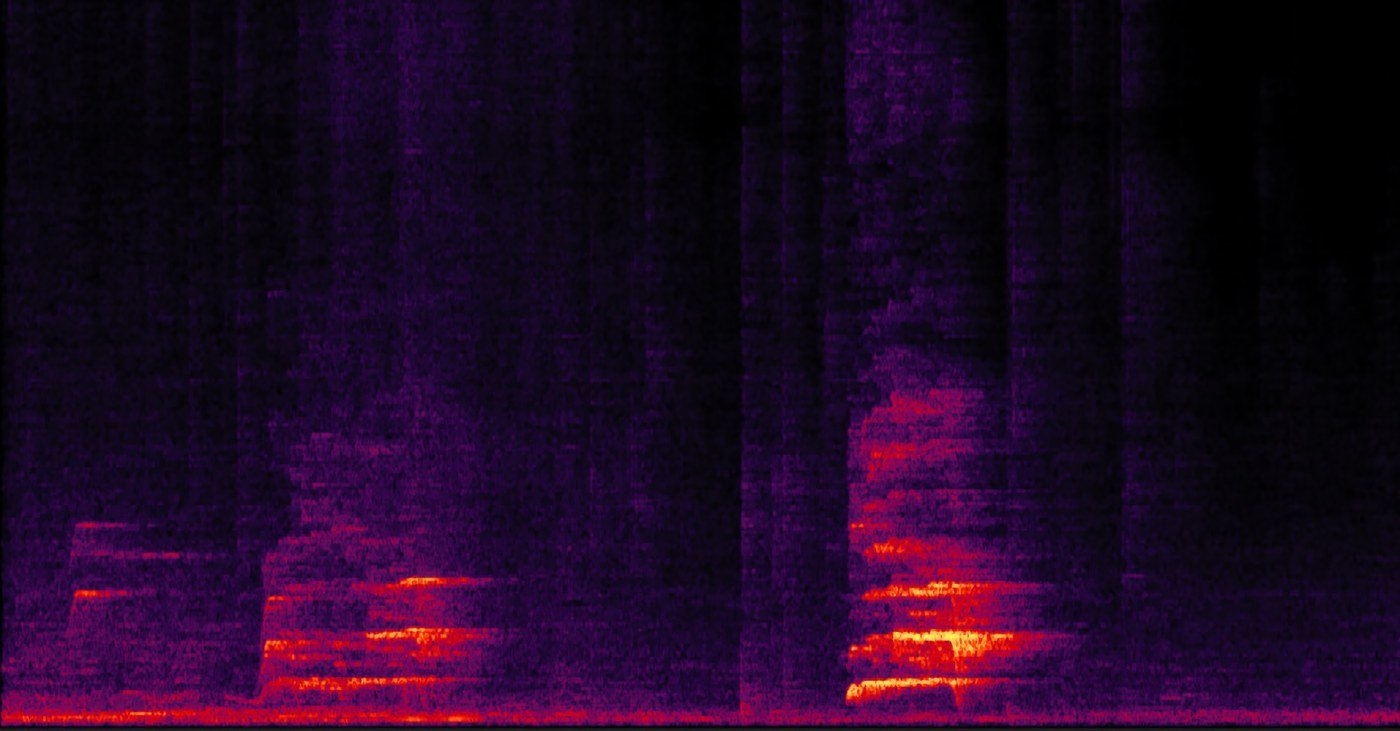
01 · Recording
Audio captured during search and rescue operations in Samandağ, Hatay, the day after the earthquake.
02 · FFT analysis
The signal is decomposed into frequency bands over time, producing a spectrogram: a fingerprint of the sound.
03 · Generative form
Each frequency band displaces the surface in space-time. The result is a visual and tangible interpretation of the recording, then 3D printed in SLA resin.
Recorded
2023-02-07 · 12:51Hatay, Türkiye
Location
36.087933, 35.989620Samandağ, Cumhuriyet Mah.
Method
FFT → generative designReal-time transformation
Output
Digital + physicalNFT (60 ed.) · SLA print · film
“Each ridge on the sculpture’s surface is shaped by a different sound frequency.”
“While this method builds a bridge between memories and form, it transforms the auditory memories we perceive temporarily into a multidimensional, tangible and permanent one.”
The work
The sculpture forming, in sync with the sound
The film is the artwork in its original state: the form grows in real time as the recording plays, each frequency raising its own ridge. Watch with sound on.

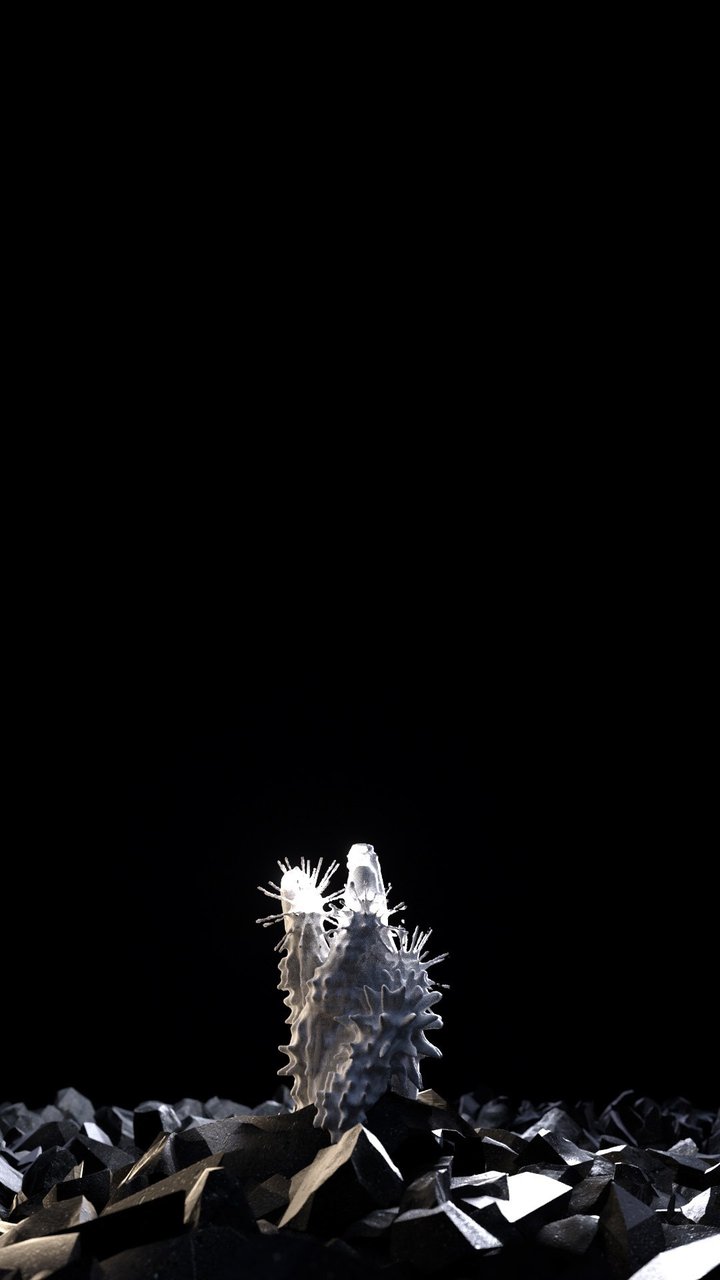
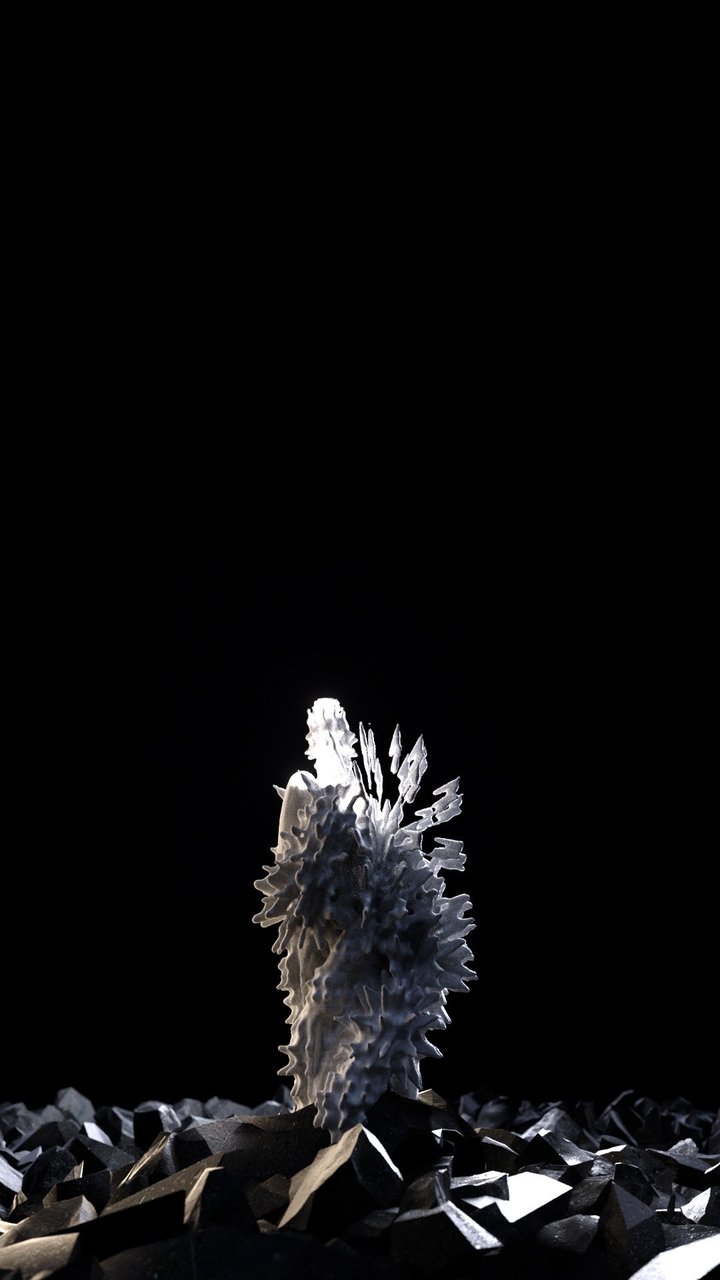
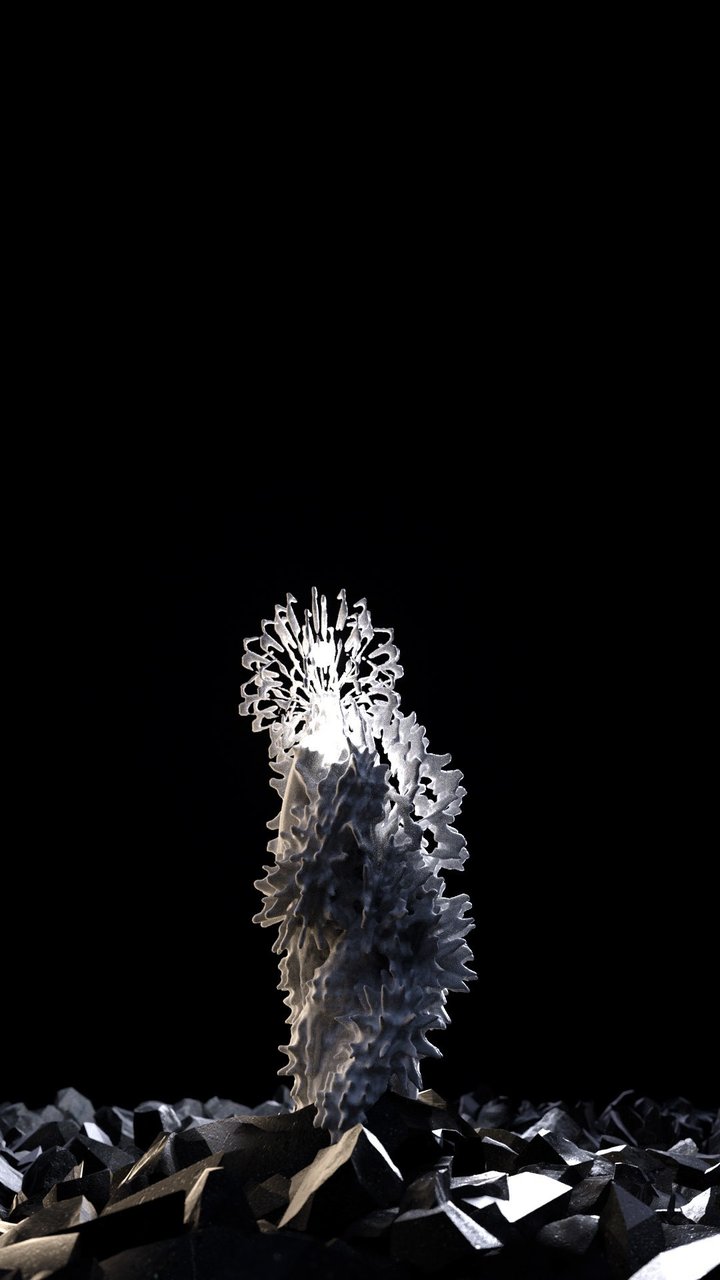
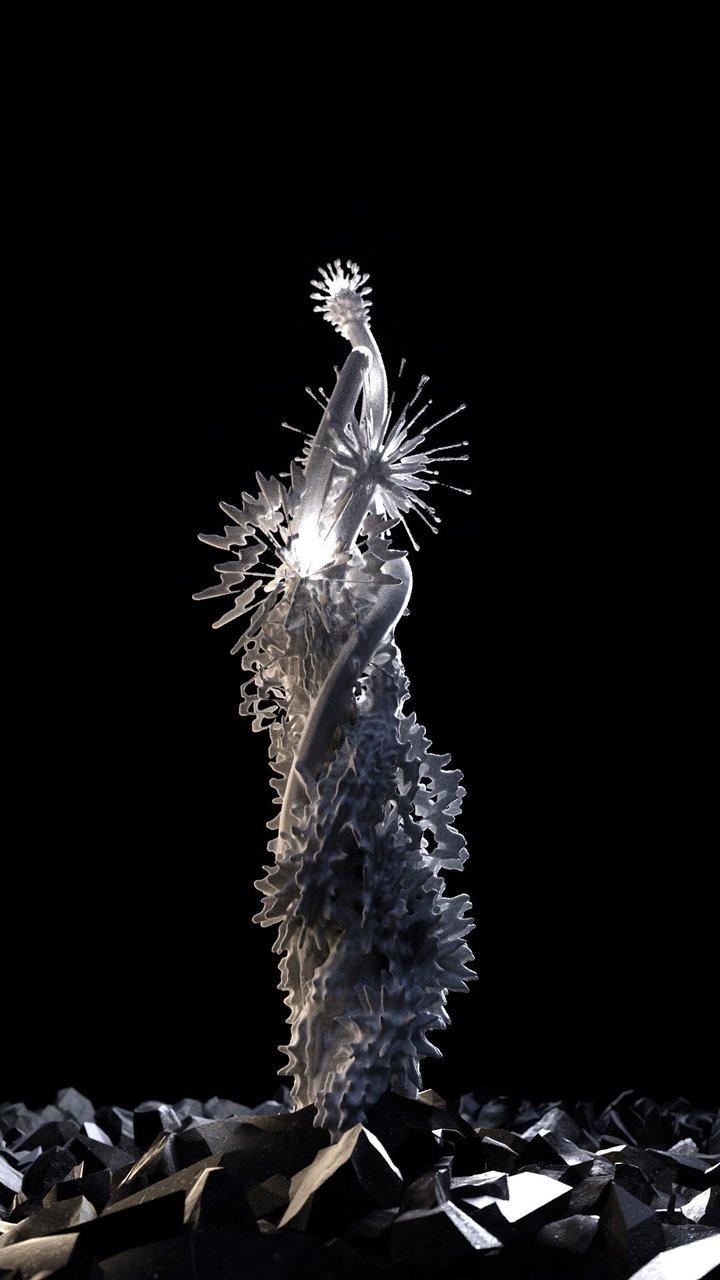
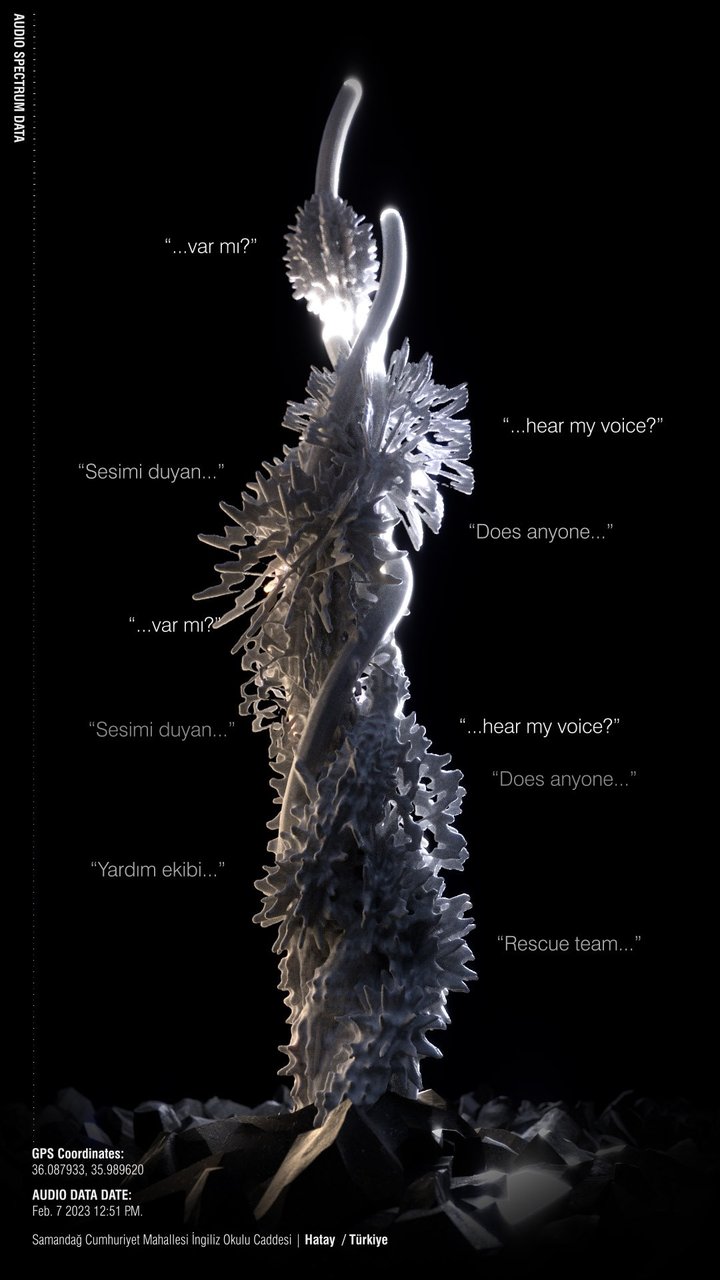
Frames from the generation sequence. The complete form is reached when the recording ends.
Documentary
The story behind Call for Life
How a rescue recording from Samandağ became a sculpture, an NFT that funded relief, and an exhibited work: the process, the method and the people involved, told by the artist.
İGA ART proposal · 2023
A 32-metre monument for İstanbul Airport
For the İGA ART Art Projects Competition, Call for Life was proposed at monumental scale: a 32-metre sculpture rising from a field of rubble in the terminal, with a kiosk beside it playing the generation film and the recording. It placed in the top 10 of 172 entries.
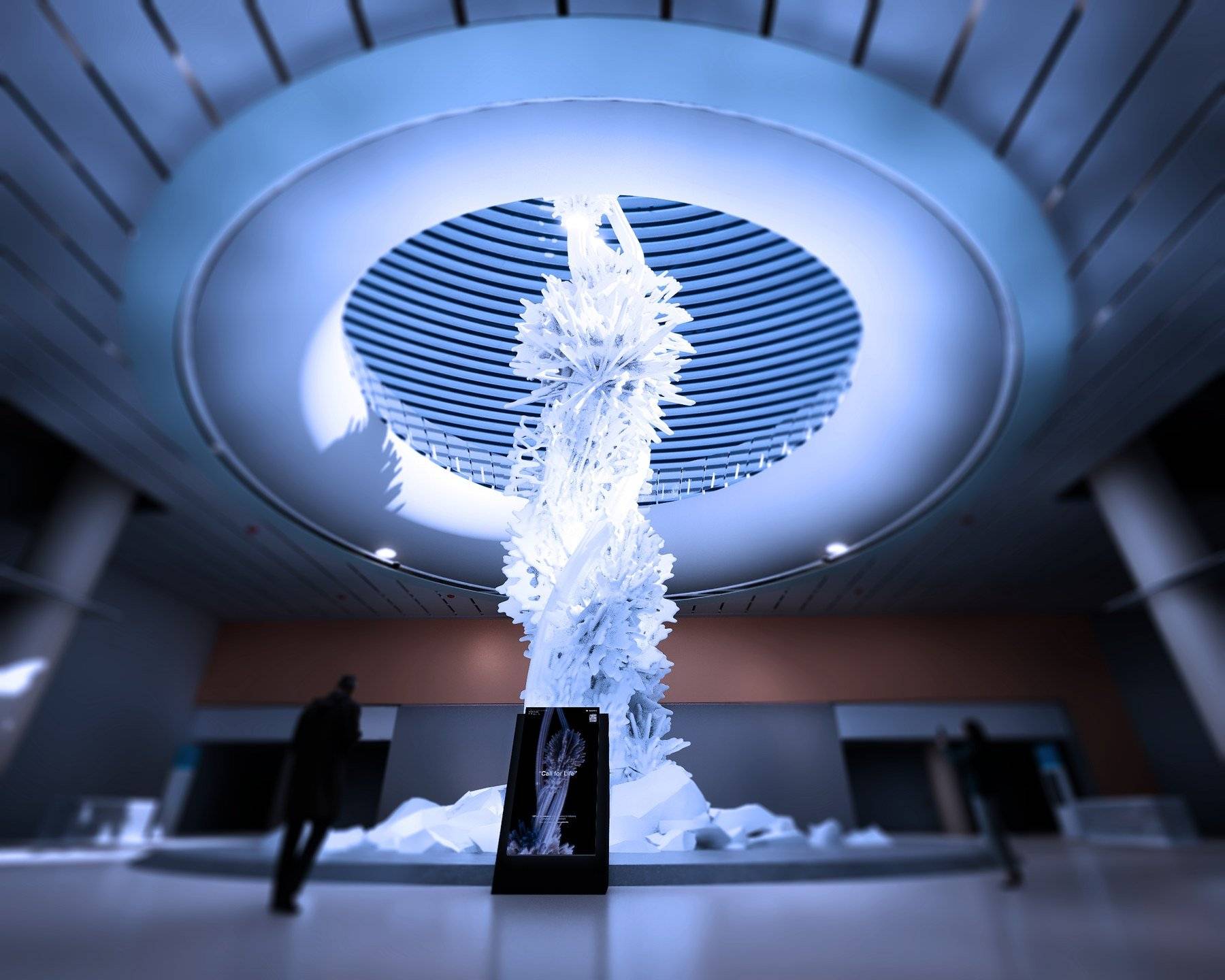
Visualisation, İstanbul Airport terminal, with the kiosk that plays the generation film and the recording
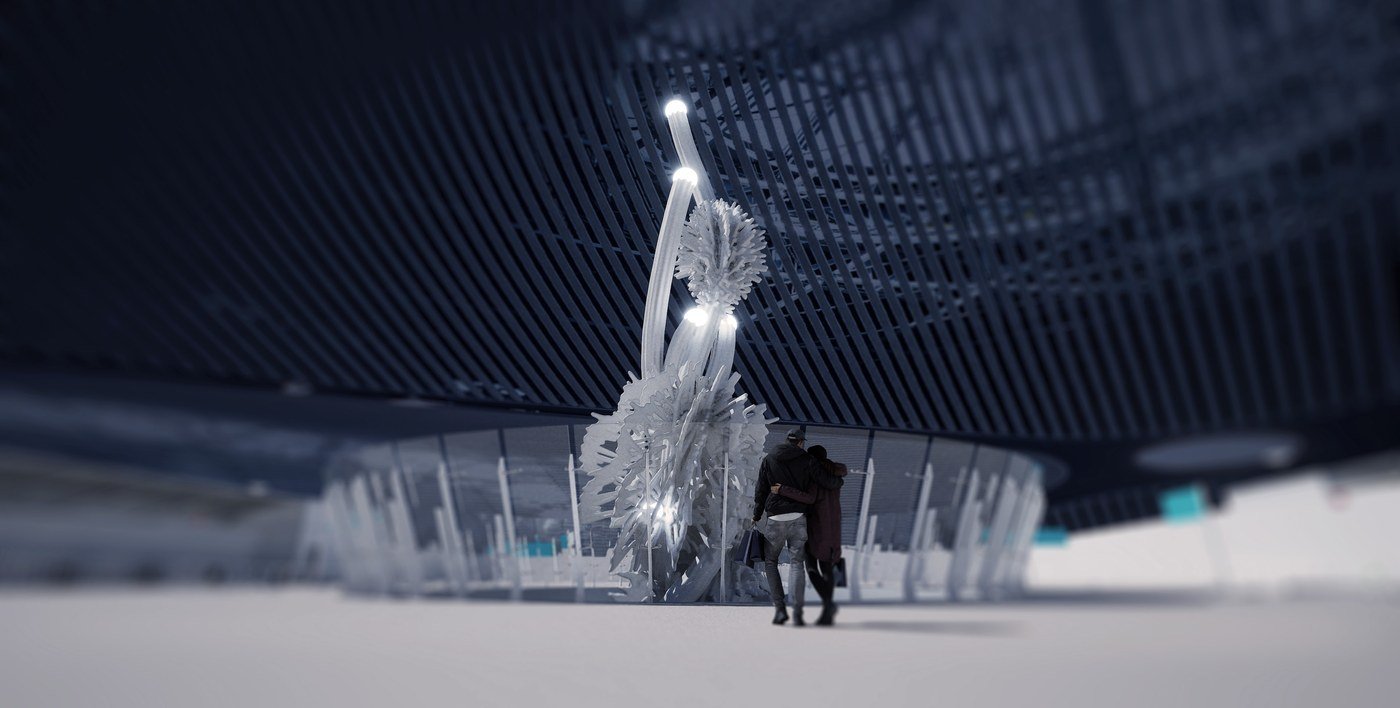
The spherical lights refer to the lamps of the rescue teams
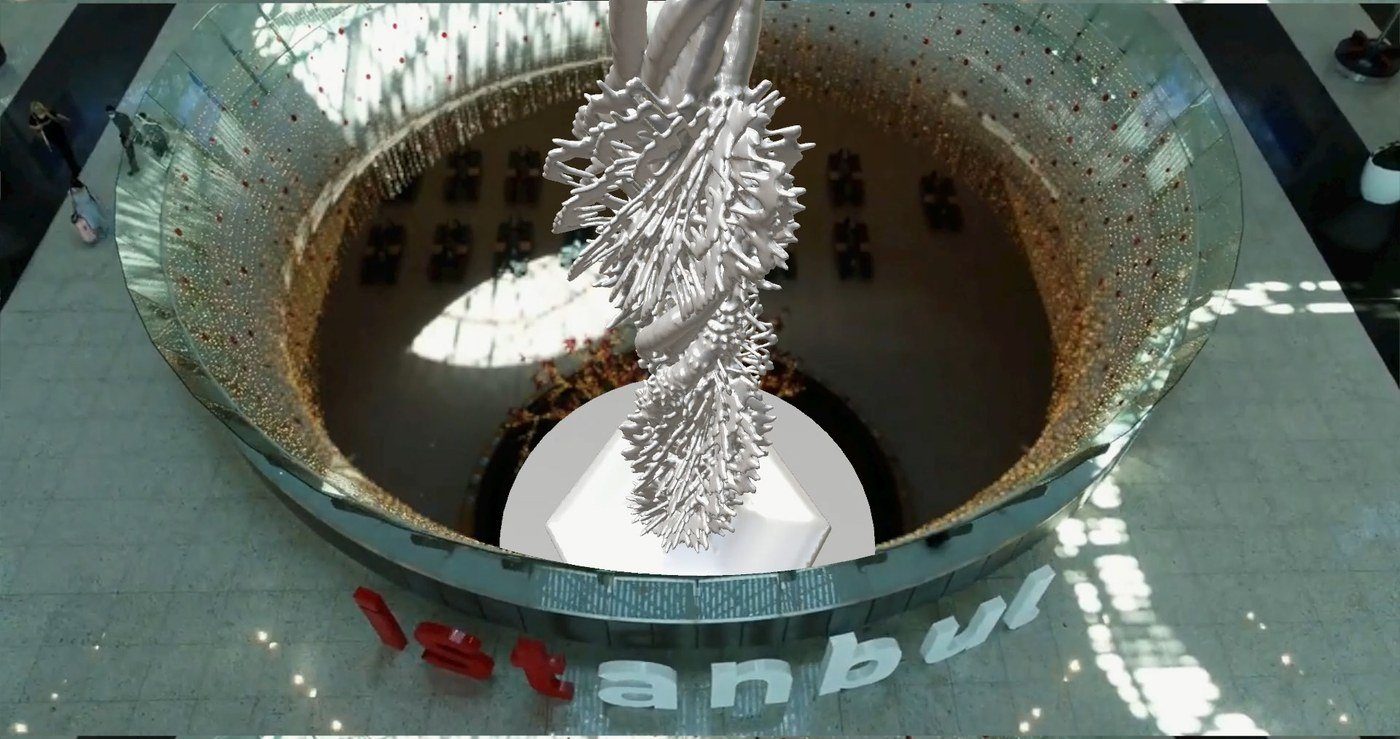
Rising through the void, seen from the upper level
Proposal film · the sculpture at scale in the terminal
- Height
- 32 m
- Width
- 6 m at the widest ring
- Weight
- ≈ 7,000 kg, part-suspended from the dome
- Material
- PLA bioplastic, printed in a 3D grid of parts
- Production
- FDM pellet extruders on 6-axis robot arms, 3–6 mm layers; spray-coated, matte white
- Lights
- Spherical LED lamps, a reference to the rescue lights
- Kiosk
- Generation film with the recording, translated, and a donation channel
Views
Render and object
The work exists in three states: the film and NFT, the SLA-printed edition first shown at the İGA ART exhibition, and the monumental proposal above.
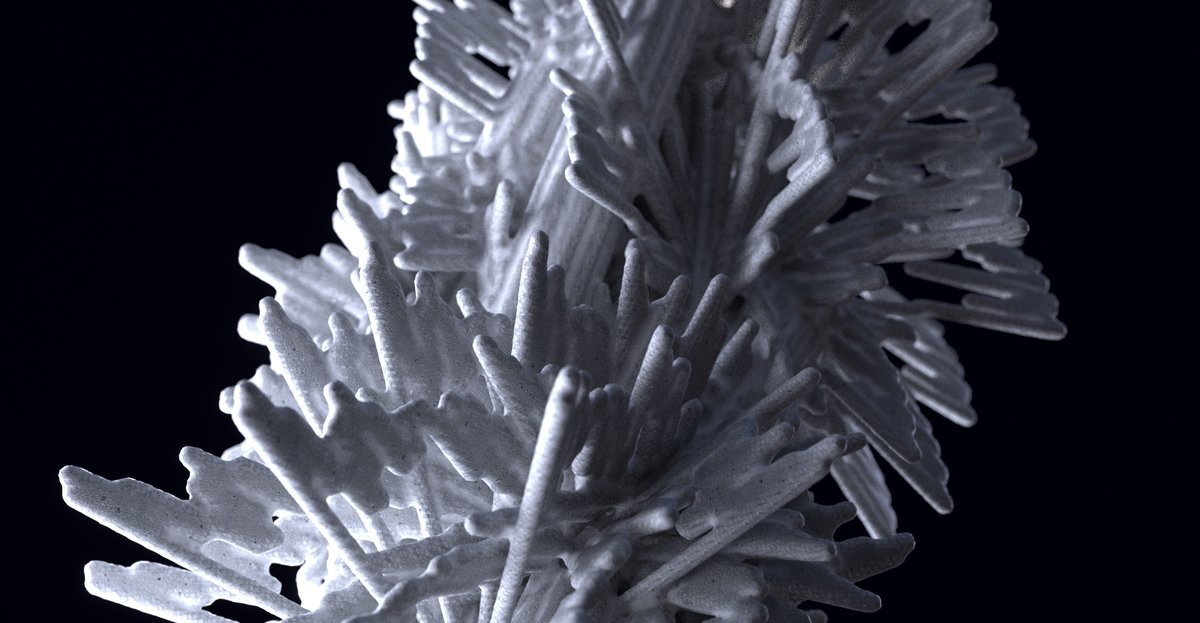
Digital sculpture, detail
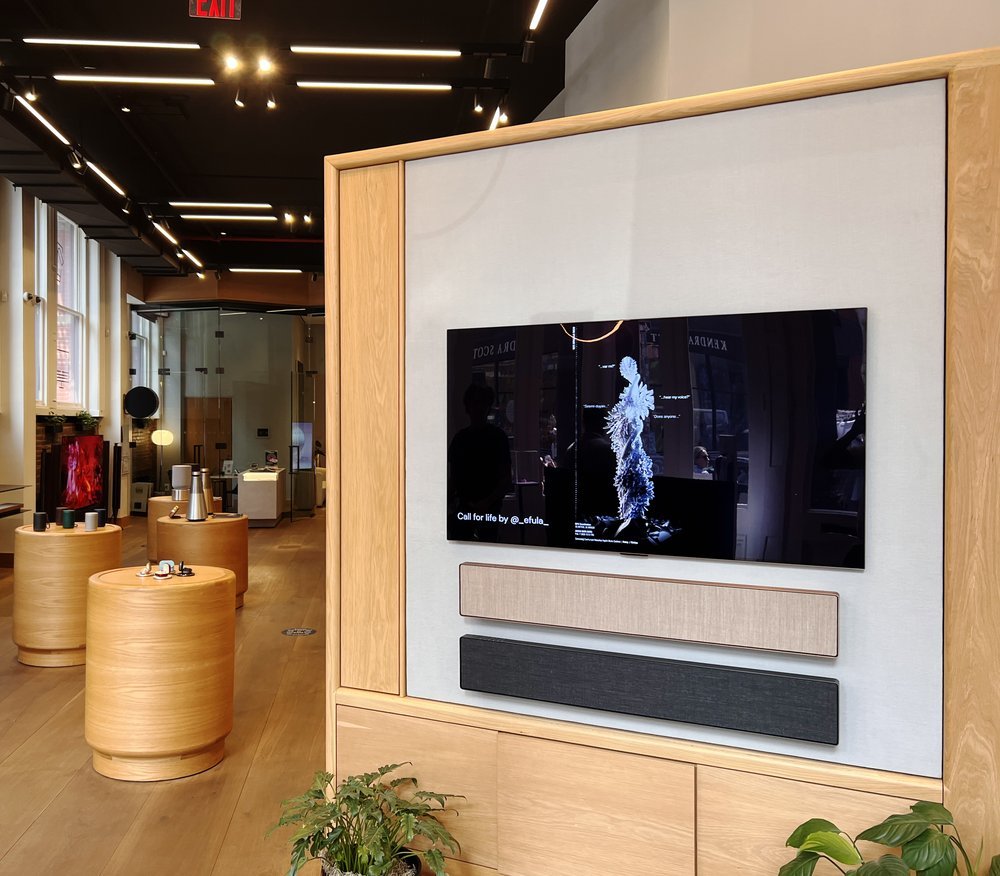
Bang & Olufsen flagship, Soho, New York, 2023
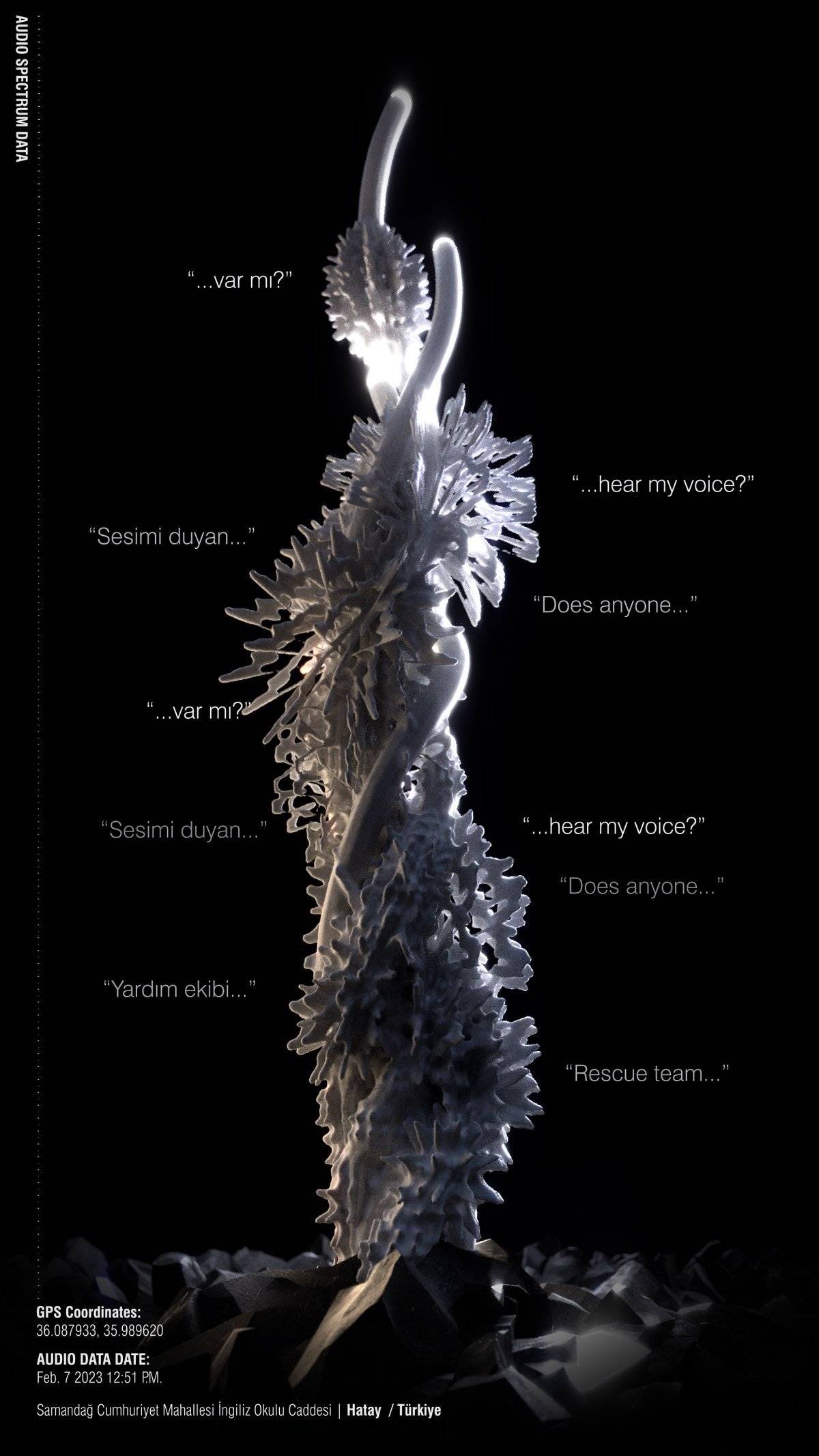
Digital sculpture, with the words of the recording mapped to the form
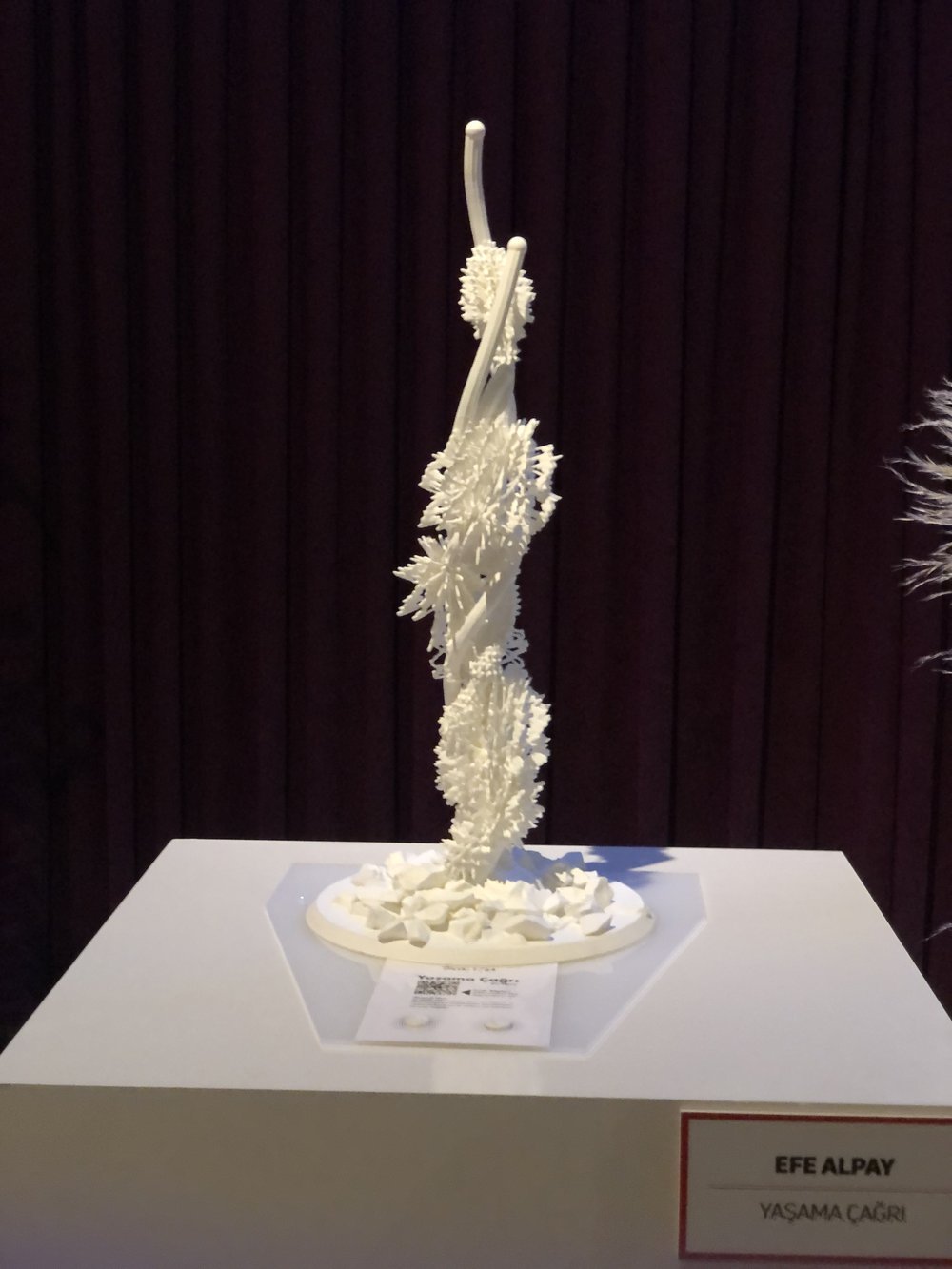
SLA print, İGA ART exhibition, 2023
Recognition
Where the work has been
- Feb 2023NFT release for earthquake reliefSixty editions on Manifold, sold out. 100% of proceeds donated to earthquake relief.
- May 2023Bang & Olufsen × SuperRare Web3 Exhibition, New YorkOne of 15 works selected from more than 500 submissions, shown at the B&O flagship store in Soho, Manhattan.
- Nov 2023İGA ART Art Projects Competition, Top 10Selected from 172 entries for İstanbul Airport’s art programme; the proposal scales the form to a 32-metre sculpture made with 3D printing and industrial robots. Physical edition exhibited at Cer Modern, Ankara.
- 2024TMMOB Chamber of Geological Engineers Service AwardCited for “concretizing memories and creating collective memory by utilizing innovative thinking and technological capabilities.”
- 2024Lumen Prize, Impact Award FinalistAmong 65 finalists chosen from around 2,000 submissions to the world’s leading prize for art made with technology.
Context
Call for Life is the first of the Mnemonic Data Sculptures, a series that grew out of Efe Alpay’s doctoral research, Sound Data as Design Material (METU, Industrial Design). The thesis developed a method for transforming memory-related data, especially sound, into three-dimensional physical forms: a way to give ephemeral, personal or collective memories a lasting, tangible presence.
Call for Life was made in the weeks after the doctoral jury, when the earthquake interrupted the final corrections to the thesis. It became the first test of the method on a collective rather than a personal memory, and it asks the question the thesis began with: can collective memories and personal data be used to create meaningful and valuable artifacts? Later Mnemonic Data Sculptures build on what this work established.
